Neuroscience of Love: How to Keep Love Strong

neuroscience_on_love“Does he love me?” This is the question I heard most often while consulting on intercultural couples’ relationships for over the past ten years. In the past, Koreans couldn’t understand the idea of seeing each other before establishing exclusivity. Korean women were very wary of being played. About five years ago, new words appeared to reflect the changing dating culture: Some (썸), woman person friend (여자 사람 친구), and man person friend (남자 사람 친구). “Some” means a causal relationship before becoming a boyfriend-girlfriend. Woman/Man person friend means a non-romantic friend of the opposite sex.

However, many Koreans still question whether a friendship is possible between a man and a woman. Many Korean women feel uncomfortable about their foreign boyfriend/husband’s interaction with other Korean women – whether they are a classmate, a teacher/tutor, a yoga trainer, a language exchange partner, a coworker, or a neighbor. The reason why a lover’s opposite-sex friend (for heterosexuals) gets on our nerves is the anxiety of losing the significant other.

Anxiety arises from the activation of the amygdala within the limbic system, which is known as the mammalian brain. As indicated in the name, this part of the brain is shared by all mammals, including cats and dogs. It is an automatic defense system that detects potential danger and sends a warning signal in real time. Anxiety is a warning signal that the brain sends us to protect our survival.

For humans, reliable companions, such as family and friends, are critical to our survival. It is natural to feel anxious about those who can potentially steal our no.1 companion. However, mismanaged anxiety can ruin a promising relationship. When anxious, we get hyper-sensitive to minor change in our lover’s communication habits and social interactions. A concern for cheating often leads to interrogation, complaints, and even attempts to violate his/her autonomy. Unfortunately, a feeling of being on a tight leash makes people want to escape.

intercultural relationshipThen, what are better ways to manage anxiety for a happy relationship?

  1. Take Out “Me” and Think from his/her Perspective

Because we cannot measure the size of love by a ruler, we often use the quantity and quality of contact and the speed of response for a sign. When the level of communication fails to meet our personal standard, we begin to worry about dwindling love. Like other animals, people are by nature self-centered. We tend to put ourselves at the center of our thinking.

When you notice change in communication with your lover, think first in his/her position. “Is he/she busy?” “Is he/she under stress?” “Is he/she tired?” Our mental energy is limited like cellphone batteries. When tired or stressed, we have little energy left to care for others. In such situations, we don’t have energy to process complaints and instead want to be cared for. Give him/her a long (20 secs or more) hug, kisses, or caring words, which trigger the release of the love hormone oxytocin.

  1. Just Say You Feel Insecure, instead of Acting Cool

If we pretend to be cool when we are actually not, the amygdala will only raise the volume of its alarm. The brain’s primary goal is to protect our survival, so it sets off the alarm at the slightest hint of a potential threat. First, accept your anxiety and then think about what makes you anxious. The act of thinking soothes the nerves to some degree. However, when anxious, the brain tends to focus on negative information and skews uncertain information negatively. If something bothers you about your lover’s relationship with someone, just say so. Give him/her a chance to explain himself/herself. The conversation will help you determine if his/her close friend is a real threat and help ease your tension.

  1. Set a Boundary for Friendships

To minimize unnecessary arguments, set a boundary for friendships. From March 11 to 13, 2019, I conducted a survey of Korean women about their boundary for friendships with opposite-sex friends. Among 201 participants, 41% answered that they are okay with their boyfriend/husband meeting female friends if they are informed in advance, 33% leave it up to their boyfriend/husband, and 17% are okay with their boyfriend/husband maintaining friendships with female friends on SNS. Only 9% answered female friends are unacceptable. Additionally, many wrote that a one-on-one meeting with an opposite-sex friend, besides old friends, is unacceptable. Instead of restricting relationships based on sex, negotiate a reasonable boundary for friendships.

  1. Focus on Your Relationship

The best shield against cheating is strengthening your relationship. Ultimately, love is for our own happiness. Happiness discourages your lover from engaging in actions that may harm his/her relationship with you. We feel happy when the brain releases happiness hormones, such as serotonin, dopamine, or endorphin. When we feel happy, we associate the happiness with the person we are with at the moment.

The brain is wired to seek love, praise, and food because they are critical to human survival. Praise motivates us to repeat actions that are likely to be praised. For this reason, dopamine is also called a motivation hormone. So, when your lover does something that makes you happy, praise him/her generously. Just the normal routine of eating together also boosts dopamine and endorphins. In addition, happy memories increase serotonin, shielding your love and happiness against any threat!

  1. Build self-esteem

Anxiety about losing a lover often stems from a lack of self-esteem. With low self-esteem, you constantly worry about whether and when your lover would find someone more attractive and leave you. You end up seeking constant affirmation of love and trying to test his/her love. There is no one but you who can build that esteem. If you feel anxious about losing your lover, make more time for yourself by learning something new or pursuing a hobby. Time well-spent for yourself will certainly increase your charm!

This column is also available in Korean. 이 칼럼은 한국어로도 제공되고 있습니다: https://blog.naver.com/sum-lab/221493818135


Standard

Use Fear as Fuel!

Yesterday, I skipped posting on my blog but still completed my One Thing for Me a Day. I started the day with meditation, rode the stationary bike for 30 minutes, and cleaned the house. At night, I binge ate a Margarita pizza, strawberries, and apples. The binge eating helped me feel happier and motivated today. Don’t feel guilty when you slip up. As long as you don’t let the slip-up stop you from forming new habits, you are still on track.

The single emotion that catches me the most has been fear. In her book the Art of Fear, Kristen Ulmer, known as the most fearless woman extreme skier, suggests that we are so addicted to who we believe we are that we are afraid of deviating from that fixed identity. Initially, our habits form our identities. If we act certain ways enough times, those behavioral patterns feel natural to us. Then, we form our own sense of ourselves – who we are and who we are not.

From early childhood, I loved to read and write, so I saw myself as a reader and writer, but not as a speaker. As a matter of fact, I was mute during most of my adolescence. Many of my classmates believed that I was physically incapable of speaking. My teachers would ask me why I wouldn’t speak. I didn’t know the answer and thought I might have trauma that I don’t remember. Now, I have a good guess. There were probably moments when I didn’t know what to say and remained quiet. It repeated enough times that I began to feel that it would be strange if I spoke.

What eventually pushed me out of my shell was a strong desire to share my ideas. I was driven to talk about my ideas. Desire stumped fear. I raised my hand whenever professors asked for presenters. Later, I would regret it, “What did I get myself into?” However, I repeated the same thing over and over again. I put myself into uncomfortable situations where I could not back out. For the last 10 years, I have participated in TV talk shows and numerous interviews, lectured to large audiences, and discovered my talent in building a quick rapport with strangers.

Although I changed a lot, fear is still part of my life. Fear is a natural emotion that all animals have to survive. Our emotional responses are triggered by the amygdala, which Seth Godin calls “the Lizard Brain.” The amygdala or Lizard Brain is a 500-million-year-old structure that all animals share. It creates emotional responses to call on the body to take appropriate action. Fear is the most fundamental emotion for survival. To protect our lives, fear drives us to take action – fight, flight, or freeze.

What makes humans distinctive is the youngest part of the brain called the prefrontal cortex. We humans have the proportionally largest prefrontal cortex of all mammals. After receiving emotional responses from the amygdala, the prefrontal cortex interprets the information and makes judgments and decisions. What it means is that we cannot control our first emotional reaction but we have the power to change our feelings.

The lizard brain is a wimp and slacker. It loves the status-quo and certainty. It refuses to budge until an imminent danger triggers off an emergency alarm. To the lizard brain, uncertainty is scary and certainty is comfy and irresistible. So, in fear, we procrastinate and look for all kinds of excuses to not change. Kristen Ulmer emphasizes the key to overriding fear is to embrace it. Accept that you are scared and switch your focus from resisting fear to thinking about what scares you – the situation at hand. Then, you can think about your next move.

american shorthairOnce we take the first action, fear quickly subsides. Our large prefrontal cortex sometimes makes us overthink. Follow what cats (or dogs) do! When my kitties hear an unusual sound, they get up to see if there is a real danger. In our lives, change involves accepting things that are unfamiliar, unknown, and thus scary. As Kristen Ulmer says, fear is a sign that we are on the right track for growth. Use fear as fuel. Fear is fuel. Forget who you think you are. Make a new self! Habits will make us become who we want to be. Soothe your fear by simply doing One Thing for You a Day!
Please like my page and find your own inspiration: https://www.facebook.com/onethingformeaday/

Standard

Use the Binary Mind to Conquer your Fear!

As expected, I am getting busier with work. When I got up today, I felt a bit overwhelmed. “I have a lot of work to do. How can I find time to write my blog article?” In the shower, I thought of the Pomodoro Technique that I learned from many self-help books. It is a time management technique that uses a timer to set time blocks for each of our tasks. The goal is to complete a task within the set timeframe. I decided to set two hours for each of my tasks. This technique helped put me at ease and focus my full attention on my tasks. In the end, I completed each task, including writing a blog article, in two hours.

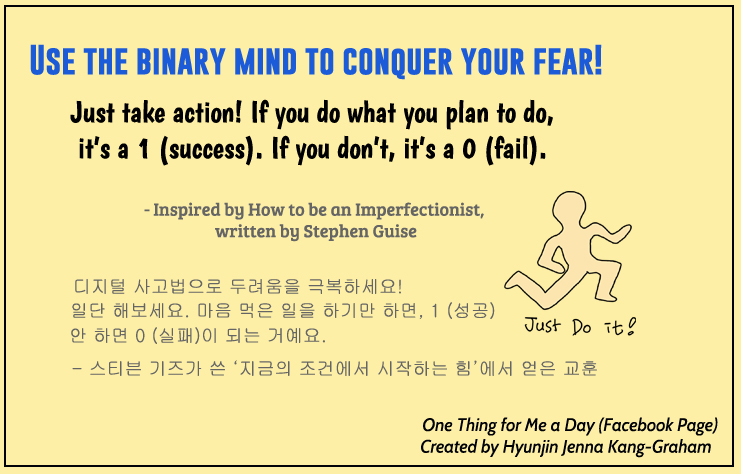
The biggest change that One Thing for Me a Day has made in my life is that I can get started, regardless of my level of motivation, physical condition, or emotional state. Although I felt heavy this morning, I still meditated and rode a stationary bike. Once I got on the bike, I continued for 30 minutes. The exercise led me to shower, and the shower awakened my body and mind. In his book, “How to Be an Imperfectionist,” Stephen Guise, one of my biggest inspirations, emphasizes the power of action over thinking. Action changes our feelings, much more than thinking does.

Stephen Guise suggests that perfectionism pulls us back and stunts our growth by causing anxiety and self-doubt and preventing us from starting. On the other hand, imperfectionism nudges us to get started by switching focus from results to process. I have long pursued the unattainable dream of a perfectionist. It is a common tendency among Korean people. In Korean culture, there are core social values known as “saving face” and “losing face.” We are taught to look our best at all times. We lose face when we make mistakes. And we are more likely to be criticized for mistakes than praised for accomplishments.

I was often afraid to try something new because I didn’t know if I could do well or not. However, to grow and achieve goals, we need to start and then see what happens! When we are trying anything new or pursuing new goals, there is no way to know what is going to happen. Actually, that is the fun of life. The flip-side of uncertainty is possibility. Stephen Guise also suggests that our action is driven by the battle between fear and desire. If fear stumps desire, we procrastinate. His secret to overcoming fear and procrastination is the binary mindset, along with small goals. Rate your action with only two numbers, 0 or 1. If you did, it’s a 1 (success). If you didn’t, it’s a 0 (fail). As long as you take action, you win.

When I first started my One Thing for Me a Day project, I set super-easy goals, as inspired by Stephen Guise’s Mini Habits. My only goal was to do just one thing for me a day. However, the low pressure freed me from perfectionism, leading me to do much more. I thought I would write only a few sentences on my Facebook page to keep track of my daily action(s), but I am writing one blog article every day in Korean and English. I also draw an image to go with my article. Because of the fear of being not good enough, I hesitated to draw again after I stopped drawing almost 20 years ago. Now, I write and draw every day. I will continue and see what happens!

Please like my page and find your own inspiration: https://www.facebook.com/onethingformeaday/

Standard

Control Your Time to Your Advantage!

My excuse for ordering delivery food and not exercising has always been “I don’t have time.” It is true that I often worked to exhaustion. I believed the number of hours spent and exhaustion indicate hard work. Many businesses still pay their employees by the hour. As a communication consultant, I consult on clients’ content and rewrite it. I used to spend an entire week working on one resume. If I got it done quickly, I felt like I didn’t put in my 100%. Now, I can get the same work done in a few hours. It is not only because I have over 10 years of experience, but also because I learned to manage my time.

By being aware of our perception of time, we can make our time go by slower or faster to our advantage. In his book, the Power of Time Perception, Jean Paul Zogby, suggests that the brain’s information processing speed affects our experience of time. When the brain processes sensory information faster, we experience time running slower. My favorite MMA fighter was Anderson Silva. He seemed to be able to see a split-second opening in his opponent’s defense. That was probably because he was so focused and saw every movement in slow motion. Simply put, when we are focused and alert, our brain is sharp, getting more work done in a shorter time. More free time!

cute kittySometimes, we want time to run faster. I want my exercise time to go by quickly. When I am on the stationary bike, time seems to creep by. Zogby suggests that we experience time through change. All I do on the stationary bike is mindless pedaling. No change whatsoever. No wonder the stationary bike is so boring. Still, I like that it allows me to work out at home. My solution was to add change to my view during my workout. I began watching Deadliest Catch while on the bike. Seeing those high-testosterone Alaskan crab fishermen excites me and I lose track of time. Before I know it, 30 minutes go by. Afterwards, about 15 minutes of the show remains. Then, I use the extra time to stretch my body.
I no longer say “I don’t have time” because what it really means is that I don’t have time for a specific activity. I prioritize what is important to me. Yes, I don’t have time for other things that are not on my priority list at the moment. We can only do one thing each moment. After the start of my One Thing for Me a Day project, I think about what is most important to me every day and what I should learn and try the next day.

Adding new elements to life is essential to our happiness. Zogby suggests that new experiences create more memory markers. The more ‘firsts’ we create, the richer our life will become. One Thing for Me a Day is my first-time keeping track of my daily actions online – on a Facebook page and in dual languages – English and Korean. I am rediscovering the joy of writing again. Now, I am actually surprised by how quickly I wrote this post. I have so much extra time!

Please like my page and find your own inspiration: https://www.facebook.com/pg/onethingformeaday/

Standard

One Thing for Me a Day!


A couple years ago, I came across the idea of “neuroplasticity,” the brain’s ability to update throughout our lives with new knowledge and experience. This idea pulled me out of the negative feeling of ‘It’s too late to make change.’ Though empowered with this powerful idea, I still feel like I’m running in the same place.

At the beginning of each year, I make plans for self-development. At the end of the year, I realize that I haven’t done much for myself – strange given that I worked myself to exhaustion. Why? Well, I was overwhelmed by my goals to the point of mental paralysis. As a way to lift the pressure and ease my nerves, I came up with an idea “One Thing for Me a Day!

One Thing for Me a Day is a simple idea with a lot of flexibility. I just need to do one thing each day that I believe will benefit me. There’s no need to make a To-Do list, which puts me in work mode and adds pressure that I should do well. Forming new habits is the best way to change our lives. And the key to forming habits is taking super-easy mini-steps. I’m not going to set any big goals. Instead of forcing preset plans on myself, I will simply find out what I want and fulfill my desire each day.

My only expectation is that I will have a better idea of what I really want at the end of 2019. If I repeat one thing or multiple things and form new habits, those will reveal my true desires. I will also assume that things I think I want, but don’t do much to get are not my true desires.

FB image

While finding my inner desires, I will also find my inspiration from books. I will share my inspiration and my action – one thing I did each day – on my new Facebook page: One Thing for Me a Day. At the end of each week, I will write a weekly summary on this blog.
No plan. No pressure. Just One Thing for Me a Day.

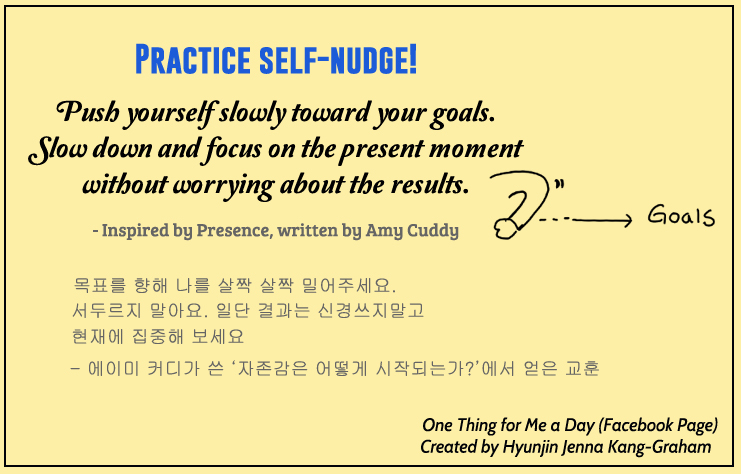
This idea is inspired by Amy Cuddy’s idea of “Presence”: “the state of being attuned to and able to comfortably express our true thoughts, feelings, values and potential.” In her bestselling book “Presence: Bringing Your Boldest Self to Your Biggest Challenges,” she suggests we “self-nudge,” pushing ourselves slowly to our goals by encouraging ourselves to focus on the present moment without worrying about the results.

A focus on end-goals or results makes us overwhelmed or impatient. On the other hand, a focus on presence or process empowers us. I want to lose six pounds and get a sexy body. That would be my goal. Then, doubt creeps in: “Can I? When?” Instead, I will just do one thing, such as ride a stationary bike for 10 minutes or play with my adorable kitty babies until I get slightly out of breath. I can do that.

I am excited about my new journey! Please like my page and find your own inspiration:

https://www.facebook.com/pg/onethingformeaday/

Standard