Try Fasting Occasionally for Your Brain

tantanmen

Tantanmen, Japanese noodles

Today, I woke up at noon. Yesterday, I went out on a date with my husband. As rewards for completing my One Thing for Me a Day project for a week, I had Tantan noodles for lunch at a Japanese ramen restaurant and a cheese enchilada, a shrimp taco, corn, and tortilla chips for dinner at a Tex-Mex restaurant. After I started this personal project, I began to think about what food or snacks are worth the carbs and sugar that switch my body to fat storage mode. So, I carefully choose what will most satisfy my taste buds on my weekly reward days. My lunch and dinner made me happy.

A heavy load of carbs and sugar makes organs work harder to digest, which seems to explain why I felt more tired and overslept. However, the sleep recharged my energy. I didn’t feel hungry so I decided to try a 36-hour fast. It has been 24 hours since I ate. Drinking water is important to brain function during fasting. Dehydration affects attention and cognitive function, damaging productivity. So, I have been drinking happy tea, a black tea infused with St. John’s Wort, an herb known for lifting mood.

Despite late rising and the fasting, I was pretty productive. Only a few hours after I awoke, I managed a client’s social media page, finished translating another client’s video script, and finished reading a book. My attention level was high. In his book the Complete Guide to Fasting, Dr. Jason Fung suggests that intermittent fasting helps us lose weight, slow down aging, prevent cancer, and increase brain function.

The process of fat-burning makes sense when we think about the brain’s priority: protecting our survival. Think about our ancestors who hunted and gathered to survive. Unlike today, food wasn’t always available. But, they still needed muscle to move their bodies and clear heads to search for food and escape from dangerous predators. Our body has evolved to store fat to use it when food is scarce.

Dr. Fung explains that the body burns fat, not muscle, until body fat goes down to under 4%. By burning fat, the body also creates ketones, which feed the brain. Ketones can meet up to 75% of the brain’s energy need, and the rest is met by gluconeogenesis, the creation of glucose from non-carbohydrate sources in the liver. During fasting, brain connectivity is increased and new brain cells are generated. Heightened brain function was critical to increase the chances of survival in the hunting and gathering days.

Dr. Fung says that an easy 12-hour fasting also helps to prevent weight gain. A 12-hour fast can be achieved by not snacking after dinner. However, to lose weight, a fasting period needs to be extended. Although I haven’t been eating for an entire day, I don’t feel too hungry. I rode the stationary bike for 30 minutes during the fasting. My energy level is just fine. But I have a slight headache. According to Dr. Fung, headaches are common during the first few times of fasting. Headaches are due to a lack of salt in the body, so drinking water with some salt may help. Drinking coffee or herbal tea with some fat (e.g., butter, coconut oil) during fasting is okay.

It’s my first time trying a 36-hour fast. I realized it wasn’t as difficult as I thought. I may try this again occasionally. Hopefully, my brain will be sharper tomorrow.

Please like my page and find your own inspiration: https://www.facebook.com/onethingformeaday/


Standard

To Live Fit and Smart, Eat Less and Move More!

Yesterday, I received my full health checkup results. I am generally healthy and the only recommendation is to build muscle through weight training. My fasting blood sugar level is 88mg/dL, which is in the normal range of under 100mg/dL. I learned from Dr. Zenji Makita’s book “You’re Eating the Wrong Food” that the key to weight loss is to keep the blood sugar level after eating under 140mg/dL. What I am trying to do now is to put health advice into practice each day. Today, I remembered that I learned about intermittent fasting in 2013.

Intermittent fasting is known to be effective for losing weight. Brad Pilon, the author of Eat-Stop-Eat, suggests a 24-hour fast once or twice a week to stay fit. The idea behind intermittent fasting is that fasting reduces insulin levels. Insulin is a hormone that converts excess glucose into neutral fat and stores it in fat cells. Simply put, when insulin levels go up, our body switches to fat storage mode. On the other hand, when insulin levels go down, our body switches to fat burning mode, as the pancreas produces glucagon to prevent blood sugar from dropping too low. Fasting is also known to slow down aging and improve brain function.

I tried intermittent fasting but I realized that I don’t want to remove the pleasure of eating from my day, even for a day a week. The key to any dietary change is sustainability. Clearly, overeating damages our health. Eating when we are hungry is okay. However, we need to be careful of the food cravings that the overconsumption of carbs causes due to rapid blood sugar fluctuations. After I have a scrambled egg breakfast, I don’t feel hungry for 7~8 hours until dinner. But, after I have a veggie pizza for dinner with a coke, I start craving more food in just a few hours.

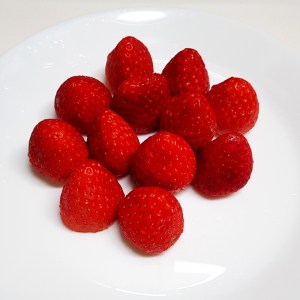
strawberriesA 24-hour fast is not sustainable for me, so I decided to finish dinner before 9 p.m. and avoid snacking. I eat dinner until I feel satisfied. I am trying to eat slower by chewing more because the brain takes about 20 minutes to feel full. I usually eat breakfast around 9 a.m. to 10 a.m., so I have about a 12-hour window between eating. I am not trying to be too strict. I love eating fruit at night. I eat bananas, strawberries, or other fruits for a snack. I may try to change the time I eat fruit to daytime.

Finding healthy snacks seems important. We can expect to want snacks from time to time. Having go-to healthy snacks will benefit us. I found a 70% cacao dark chocolate bar that uses stevia, a sugar alternative that does not affect blood sugar. Although bread of any kind raises blood sugar level, I will keep rye bread, a little better than white bread, as my snack option. I will try to drink water or get on the stationary bike to lower my blood sugar after having snacks. I believe small tweaks can go a long way. Let’s see! It’s an experiment with my own body.

Please like my page and find your own inspiration: https://www.facebook.com/pg/onethingformeaday/

Standard

Change the Brain to Change the Body!

Last year, I read more than 30 books about habits. I knew that making new habits is key to changing life. Regular exercise and a healthy diet were always a part of my New Year’s Resolutions. Last year, I was so determined to make positive changes in my lifestyle that I took a two-month break from work. I informed my clients that I wouldn’t be available until March.

Each day, I started the day with meditation, read a book, and cooked meals at home. Hooray! I felt like I finally made healthy new habits. Research shows that it takes an average of 66 days to form a new habit. I made the mark. However, once I returned to my regular work, I snapped back to my old habits, no exercise and ordering food delivery.

Among all the books I read on habits, the idea of mini-habits from Stephen Guise grabbed my attention. I liked that he emphasizes minimizing neurological and biological resistance – our mind and body’s tendency to stay in default mode. When we try to change, both our mind and body resist, as if they are saying “Just be you. Why the sudden change?” Motivation and willpower are overrated. We need to start with mini-habits that are easy and demand little motivation or willpower.

Here is the gist of the weight loss tips I learned from Stephen Guise’s book, Mini Habits for Weight Loss: Stop Dieting. Form New Habits.

  1. Start an exercise mini-habit! (e.g., 1 push-up a day)
  2. Cook one meal at home. Find a quick and easy cooking routine. (e.g., egg breakfast, stir-fry dishes).
  3. Add healthy foods to your diet! No need to ban any food.
  4. Keep track of your mini-habits.
  5. Reward yourself for your success.
habit tracker

My Habit-tracking Jar: One kitty pin for One thing for me a day

This idea of mini-habits inspired my One Thing for Me a Day idea. Today, I felt heavy and woke up around noon. Although I have been riding my stationary bike for 30 minutes lately, I wasn’t sure I could do it today. I got on the bike anyway, thinking ‘I will just do it for 10 minutes.’ Once I got started, it seemed easier than I thought. Eventually, I did it for 30 minutes as usual. The exercise boosted my mood and I read a book and wrote a new blog article as I have done for the last four days.

Please like my page and find your own inspiration: https://www.facebook.com/pg/onethingformeaday/

Inspiring Quote: “I fear not the man who has practiced 10,000 kicks one, but I fear the man who has practiced one kick 10,000 times” – Bruce Lee


Standard

Eat Right and Get Slim!

kittiesDespite the importance of food in health, I haven’t paid much attention to what I eat. Having children often changes people. It was the same for me. Last spring, I adopted two adorable kittens. As soon as I became responsible for the life of these little beings, I felt compelled to learn about proper nutrition. After some research on feline nutrition, I realized that a lack of knowledge is harming the health of our furry companions. Although cats are obligate carnivores, many cat parents in Korea feed high-carb, low-fat dry food to their cats because of the widespread misperceptions that high protein causes diarrhea, fat causes obesity, and wet food causes tartar buildup. I also learned that we are damaging our own health due to misinformed nutritional beliefs.

Dr. Zenji Makita, a well-known diabetes specialist in Japan, debunks many nutritional beliefs. He emphasizes that the primary cause of obesity and diabetes is carbs, not fat or calorie intake. This is because carbs increase blood sugar levels and the state of high blood sugar causes obesity. Carbs are turned into glucose in the body for energy. Glucose is critical to our brain and body functions. Due to its importance to our survival, glucose is fully absorbed into our body. Excess glucose, or unused energy, is turned into neutral fat to prepare for emergency (famine) situations, which nowadays we usually don’t have. Then, we become fat. The fat we eat is not stored as fat because we excrete most of the excess fat we consume.

Here is the gist of the dietary tips to get slim that I learned from Dr. Makita’s book, You’re Eating the Wrong Food:

  1. Cut down on carbs (e.g., white rice, white bread, potatoes). When consuming carbs, eat with fat. Fat helps blood sugar levels rise slowly.
  2. Cut down on sugar. Be wary of hidden sugar (e.g., canned coffee)
  3. Eat more protein (e.g., beans, tofu, fish, unprocessed meat)
  4. Eat more fiber: two handful of leafy vegetables a day, seaweed, mushrooms
  5. Eat a moderate amount of healthy fat (e.g., olive oil)
  6. Eat fruits moderately. No fruit juices. Overeating fruit causes weight gain because fruit sugars are not an energy source and so are quickly turned into fat.
  7. Drink two liters of water. Water lowers blood sugar levels.
  8. Eat plain yogurt with blueberries in the morning. It helps increase good gut bacteria, which is critical to staying slim.
  9. Snack on nuts, natural cheese, and over 70% cacao dark chocolate.
  10. Exercise for 20 minutes after eating. Exercising with an empty stomach causes overeating and blood sugar spikes, making us fat. Exercising after eating prevents blood sugar from rising, making us slim.

Changing eating habits is a journey of finding healthier alternatives for our favorite foods. Any behavior change that relies on willpower is bound to fail. Like battery power, our willpower is limited. If we use our willpower to resist the temptation to eat the food we like, we will lose the willpower to do other important things. In the same way, if we use our willpower to get work done or manage stress, we won’t have enough willpower left to resist the temptation.

That’s why it’s so important to find healthier alternatives that we like as much as our current favorites. I love high-carb food, such as bread, pizza, pasta, ramen, and potato fries. Instead of cutting bread from my diet, I found a rye bread that I actually enjoy more than white bread. And I decided to make my favorite foods more special than they are now. I make them into rewards that I need to earn. When I stick to my One Thing for Me a Day plan for a week, I will reward myself with any food item of my choice.

Please like my page and find your own inspiration: https://www.facebook.com/pg/onethingformeaday/

Standard