
Names matter because they create a shortcut to an identity. Names frame our perception. Creating globally-appealing names can be tricky because the language barrier adds another layer of difficulty. Imagine a situation when your foreign friend or colleague says, “How’s it going, [your name]?” In your head, you would be thinking, ‘Oh gosh, what’s her name? She taught me how to say her name. This feels awkward.’ We feel awkward when we can’t pronounce a name, leading to emotional distance. The same goes for brand names.
As a market research analyst, I often conduct research on consumers’ perception of brand or product names and descriptions. The worst names are the ones that are difficult to pronounce or remember, which go hand-in-hand. If you don’t know how to pronounce the brand name, you are likely to forget it. To appeal globally, a name should be easy to say. Think of popular global beauty brands: Aveeno, Benefit, Dior, Mac, Olay, SK-2, or Make Up Forever. One of my favorite Korean beauty brand names is SkinFood, with a catchy tagline, “Don’t eat it. Give it to your skin.” With any of these names, you don’t need a pronunciation lesson. They are mostly short, or even if a little longer, they are made up of familiar everyday words.
A brand name should also evoke an image or feeling that is connected to your brand– whether it is the ingredients, benefits, or character/personality. Think of any names that make you feel happy. It could be the name of a loved one. You have an emotional connection to that name. It brings up your memories of having good moments with that person. You can create a brand name that builds a similar emotional connection with consumers by aligning it with a compelling brand story.
 Brand name expert Alexandra Watkins stresses that captive brand names should be visually evocative to aid memory and drive a positive emotion – that is, to make people smile. One of my favorite skincare brands is Lush. This brand name reminds me of lush forests and bubbles. In its brand story, Lush emphasizes its fresh, 100% vegetarian ingredients. Its products have fun and imaginative names. Take the bath bomb. When I hear this name, I imagine comforting bubbles filling up my bathtub – a relaxing bath experience. Each bath bomb also has unique, whimsical names, such as Sex Bomb and the Big Sleep, reflecting its shape or benefit. Although one little bath bomb costs about $10 or more in my country, I can’t resist.
To create an emotional connection, we always have to start with reading desire: Why do people use products like ours – the product category? Continue with why questions until you exhaust the answers. For example, why do people use a moisturizer? To moisturize their skin. Why? To make their skin soft and smooth. Why? To make their makeup apply well. Why? To make them look naturally beautiful. After you exhaust the why questions, research what words consumers use to describe their desires and the problems that need to be solved to meet those desires. Then, write your brand story about how your brand will help them solve the problems and satisfy their desires. Once your brand story is created, create a brand name that matches that story.
Take-Away: Make brand names easy-to-say and evocative of a positive experience or memory.
- Reference: Hello, My Name Is Awesome: How to Create Brand Names That Stick (Alexandra Watkins)
 The question “Why” has an almost magical power. Why do people do the things they do? Before creating any marketing content, we need to ask, “Why do people use this kind of product?” Take tourism products. Why do people travel? Besides business trips, people travel to take a break from their routine. We constantly fluctuate between two conflicting desires: desire for stability and desire for change. Too much stability creates boredom, while too much change creates anxiety or even fear. Travel provides a safe way to experience change.
 Using common experiences is a great way to add familiarity. Experiences that we appreciate are not all that different across cultures, such as spending time with loved ones, enjoying hobbies, and eating delicious food. There is no need to push too hard to find unique experiences to promote. Just see what people like to do in a promoted destination. And showcase the locals: what they like to eat and do, or where they like to go. Airbnb appeals exactly to this desire with its slogan, “Live Like a Local.” No one wants a tourist trap anyway.
 I am interested in reading desire because desire motivates behavior. We act to satisfy our desires in pursuit of happiness. The goal of marketing and copywriting is to cause a certain attitude and behavior in consumers. As a market researcher, I have often seen the disconnection between marketing copy and consumers. While the company focuses on the best features of its product, consumers asks “So, what does it do for me?” To grab consumers, we need to identify what desires are connected to our products.
 Understanding consumer needs can make or break our business. Abraham Maslow provided valuable insights into human needs. Maslow suggested that we are motivated by five hierarchical sets of basic needs: physiological, safety, love, esteem, and self-actualization needs. Unmet needs cause anxiety or fear, driving us to act. What is tricky is that we are not always conscious of our needs. Our brain is wired to protect our survival, so basic needs drive our behavior on an unconscious level, which we call the fight-or-flight response. Maslow also pointed out that people tend to be unconscious of the most important and basic needs. For successful marketing, we need to address not only conscious but also unconscious needs or desires.
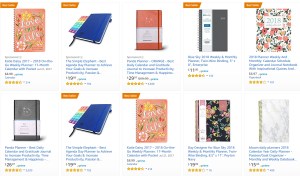 Take a planner for an example. In the beginning of the year, many people buy a planner. Search “planner” on Amazon. Currently, the most reviewed and highest ranked planner is Panda Planner, sold at $26.97~$29.97, higher than many other planners. Look at its copy: “Best Daily Calendar and Gratitude Journal to Increase Productivity, Time Management & Happiness.” In its product description, it promotes its benefit of reducing anxiety and bringing you happiness. It directly addresses the desires that drive people to buy a planner.
 When our survival needs are met, desire for happiness becomes more important. However, there is an unexpected roadblock to happiness. After living so focused on making money and succeeding in our jobs, many of us become used to living to work. For the sake of career success, we sacrifice our health and relationships – two essential elements of our happiness. Like most people around me, I worked, worked, and worked. I was doing what I was good at and making enough money to live in a nice house, eat out regularly, and travel abroad. I was supposed to be happy, but I wasn’t.
 And then, I asked myself, “What would I still want to do even if I became wealthy?” My answer was “I want to create content that impacts people.” I want to live happy to succeed and succeed to live happy, and help others do the same.
 Reading Desire