
 “Does he love me?” This is the question I heard most often while consulting on intercultural couples’ relationships for over the past ten years. In the past, Koreans couldn’t understand the idea of seeing each other before establishing exclusivity. Korean women were very wary of being played. About five years ago, new words appeared to reflect the changing dating culture: Some (썸), woman person friend (여자 사람 친구), and man person friend (남자 사람 친구). “Some” means a causal relationship before becoming a boyfriend-girlfriend. Woman/Man person friend means a non-romantic friend of the opposite sex.
However, many Koreans still question whether a friendship is possible between a man and a woman. Many Korean women feel uncomfortable about their foreign boyfriend/husband’s interaction with other Korean women – whether they are a classmate, a teacher/tutor, a yoga trainer, a language exchange partner, a coworker, or a neighbor. The reason why a lover’s opposite-sex friend (for heterosexuals) gets on our nerves is the anxiety of losing the significant other.
Anxiety arises from the activation of the amygdala within the limbic system, which is known as the mammalian brain. As indicated in the name, this part of the brain is shared by all mammals, including cats and dogs. It is an automatic defense system that detects potential danger and sends a warning signal in real time. Anxiety is a warning signal that the brain sends us to protect our survival.
For humans, reliable companions, such as family and friends, are critical to our survival. It is natural to feel anxious about those who can potentially steal our no.1 companion. However, mismanaged anxiety can ruin a promising relationship. When anxious, we get hyper-sensitive to minor change in our lover’s communication habits and social interactions. A concern for cheating often leads to interrogation, complaints, and even attempts to violate his/her autonomy. Unfortunately, a feeling of being on a tight leash makes people want to escape.
 Then, what are better ways to manage anxiety for a happy relationship?
- Take Out “Me” and Think from his/her Perspective
Because we cannot measure the size of love by a ruler, we often use the quantity and quality of contact and the speed of response for a sign. When the level of communication fails to meet our personal standard, we begin to worry about dwindling love. Like other animals, people are by nature self-centered. We tend to put ourselves at the center of our thinking.
When you notice change in communication with your lover, think first in his/her position. “Is he/she busy?” “Is he/she under stress?” “Is he/she tired?” Our mental energy is limited like cellphone batteries. When tired or stressed, we have little energy left to care for others. In such situations, we don’t have energy to process complaints and instead want to be cared for. Give him/her a long (20 secs or more) hug, kisses, or caring words, which trigger the release of the love hormone oxytocin.
- Just Say You Feel Insecure, instead of Acting Cool
If we pretend to be cool when we are actually not, the amygdala will only raise the volume of its alarm. The brain’s primary goal is to protect our survival, so it sets off the alarm at the slightest hint of a potential threat. First, accept your anxiety and then think about what makes you anxious. The act of thinking soothes the nerves to some degree. However, when anxious, the brain tends to focus on negative information and skews uncertain information negatively. If something bothers you about your lover’s relationship with someone, just say so. Give him/her a chance to explain himself/herself. The conversation will help you determine if his/her close friend is a real threat and help ease your tension.
- Set a Boundary for Friendships
To minimize unnecessary arguments, set a boundary for friendships. From March 11 to 13, 2019, I conducted a survey of Korean women about their boundary for friendships with opposite-sex friends. Among 201 participants, 41% answered that they are okay with their boyfriend/husband meeting female friends if they are informed in advance, 33% leave it up to their boyfriend/husband, and 17% are okay with their boyfriend/husband maintaining friendships with female friends on SNS. Only 9% answered female friends are unacceptable. Additionally, many wrote that a one-on-one meeting with an opposite-sex friend, besides old friends, is unacceptable. Instead of restricting relationships based on sex, negotiate a reasonable boundary for friendships.
- Focus on Your Relationship
The best shield against cheating is strengthening your relationship. Ultimately, love is for our own happiness. Happiness discourages your lover from engaging in actions that may harm his/her relationship with you. We feel happy when the brain releases happiness hormones, such as serotonin, dopamine, or endorphin. When we feel happy, we associate the happiness with the person we are with at the moment.
The brain is wired to seek love, praise, and food because they are critical to human survival. Praise motivates us to repeat actions that are likely to be praised. For this reason, dopamine is also called a motivation hormone. So, when your lover does something that makes you happy, praise him/her generously. Just the normal routine of eating together also boosts dopamine and endorphins. In addition, happy memories increase serotonin, shielding your love and happiness against any threat!
- Build self-esteem
Anxiety about losing a lover often stems from a lack of self-esteem. With low self-esteem, you constantly worry about whether and when your lover would find someone more attractive and leave you. You end up seeking constant affirmation of love and trying to test his/her love. There is no one but you who can build that esteem. If you feel anxious about losing your lover, make more time for yourself by learning something new or pursuing a hobby. Time well-spent for yourself will certainly increase your charm!
This column is also available in Korean. 이 칼럼은 한국어로도 제공되고 있습니다: https://blog.naver.com/sum-lab/221493818135
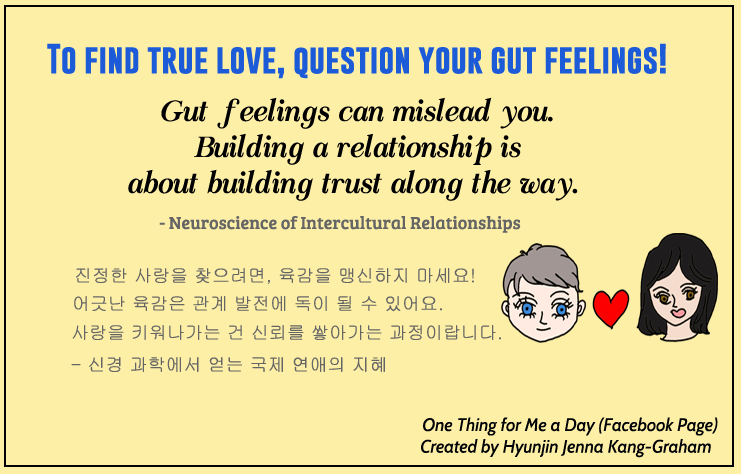



 Once we take the first action, fear quickly subsides. Our large prefrontal cortex sometimes makes us overthink. Follow what cats (or dogs) do! When my kitties hear an unusual sound, they get up to see if there is a real danger. In our lives, change involves accepting things that are unfamiliar, unknown, and thus scary. As Kristen Ulmer says, fear is a sign that we are on the right track for growth.
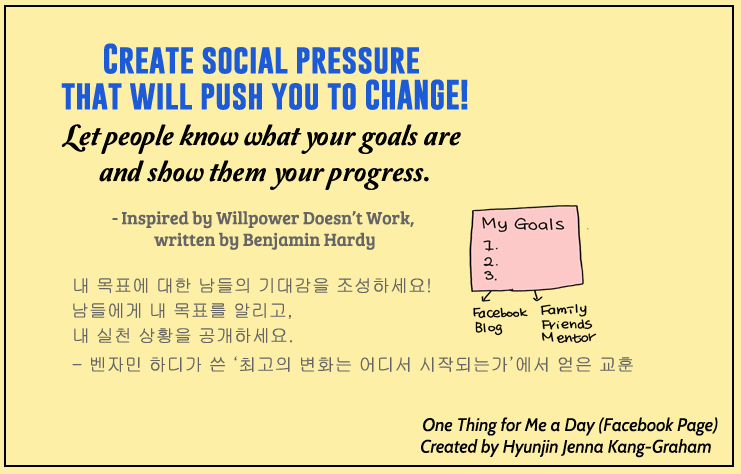
 Today, I broke my fast at 9 a.m. after 36 hours. The fasting didn’t make me hungrier than usual. I had a two-egg scramble with asparagus, Brussels sprouts, chickpeas, and cheddar cheese, and some fresh mozzarella and strawberries on the side. I wanted to replenish my body with rich protein and vitamins. I also had a cafe latte spiced with cinnamon, which helps to lower blood sugar and prevent weight gain.
 Since 2019 began, I have been meditating, exercising, and writing every day, and cooking at home most days. In the past two weeks, my weight is down from 53kg (117 lbs) to 51kg (112 lbs). Today’s weight is after the 36-hour fast, so I expect it to go up a bit. Because my focus is forming a habit, not reaching a specific weight loss goal, I do not weigh myself every day.


 Reading Desire